Quick summary
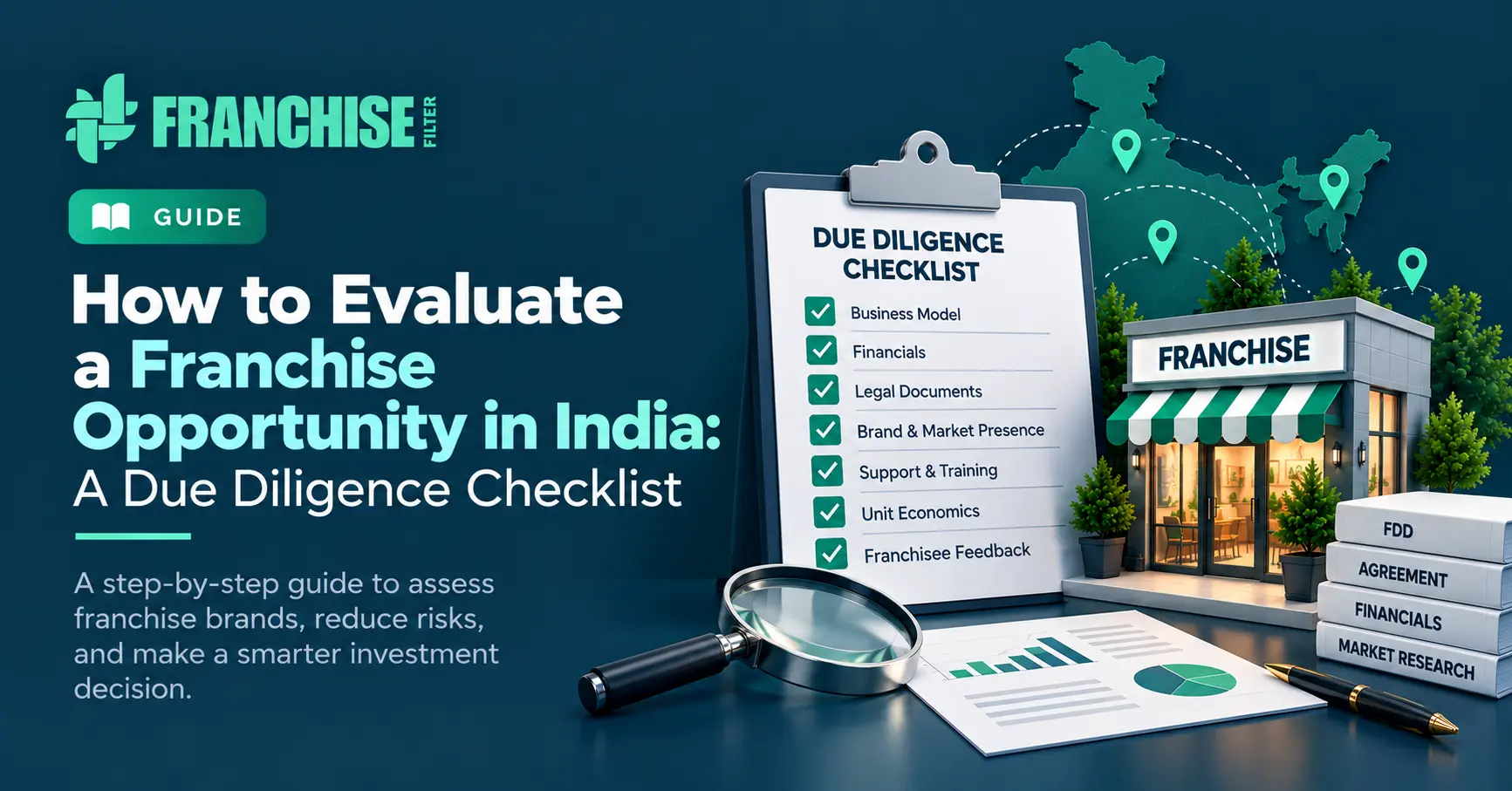
Evaluating a franchise in India comes down to seven checks, done in order. Confirm the company exists. Confirm it owns the brand it is licensing to you. Check its real outlet record. Talk to franchisees you picked yourself. Build your own numbers. Read the agreement clause by clause. Then have a lawyer review it before any money moves.
Two people signed franchise agreements in the same month. One spent an afternoon on the trademark registry and found the brand was registered to a different company from the one on his contract. He walked. The other signed and found out fourteen months later when a legal notice arrived from the actual owner of the name above his door.
That is the whole case for due diligence. It is not paperwork. It is the difference between a business and a very expensive lesson.
Stage 1: Confirm the company behind the franchise business actually exists
Before anything else, check that the entity on your draft agreement is real, active and filing its returns. This takes about twenty minutes and costs nothing.
Step 1: Look up the company on the MCA portal
Go to mca.gov.in and open the master data search for companies and LLPs. Enter the exact name on your draft agreement, not the brand name you see on the shopfront. They are often different.
Confirm the company status shows as active, not struck off or under liquidation.
Check the date of incorporation. A brand claiming ten years of history from a company registered last year needs explaining.
Note the registered office address and compare it with the address on your agreement.
Look at the directors and whether annual filings are up to date.
Check for registered charges, which show what the company has borrowed against.
Step 2: Verify the GST registration
On gst.gov.in, use the search taxpayer tool with the GSTIN printed on their invoice or quotation.
Confirm the registration is active and the legal name matches the MCA record.
Check the date of registration against the trading history they claim.
If they cannot give you a GSTIN at all, stop here.
Stage 2: Confirm the brand owns the trademark it is licensing to you
This is the single most skipped check in Indian franchising, and the one that causes the worst outcomes. You are paying for the right to use a name. Make sure the person selling it owns it. Every serious franchise business in India will pass this test easily.
Step 3: Search the mark on the IP India portal
Use the public trademark search on the IP India online portal at ipindiaonline.gov.in. Search by wordmark, using the brand name exactly as it appears on the signage. Then check three things, in this order.
Check the status, not just that a record exists
A record existing is not ownership. The status line tells you where the application actually stands.
Status you may see | What it means for you |
|---|---|
Registered | The mark is owned. This is what you want to see. |
Accepted and Advertised | Published for opposition. Close, but not final. |
Objected | The examiner raised objections. Not yet owned. |
Opposed | A third party is challenging it. Real risk. |
Abandoned or Refused | The application failed. The brand does not own this name. |
Check the class
Trademarks are registered by class of goods or services. A mark registered for clothing gives no protection to a restaurant. Confirm the registration covers the category you are actually opening in.
Check whose name it sits in
This is the one that catches people. If the mark is registered to a director personally, or to a different group company, then the entity you are contracting with may not own what it is licensing you. Ask for the licence chain in writing, and have your lawyer confirm it links up.
Stage 3: Check the brand’s real outlet record, not the brochure number
Brands quote a total. The total is the least useful number they have. Ask for five figures instead, in writing.
Total outlets currently trading, by city.
Outlets opened in the last 24 months.
Outlets closed in the last 24 months.
Outlets transferred to new owners in the last 24 months.
How many of the total does the company own and run itself?
Closures and transfers are what the total hides. A brand that opened 40 and closed 18 is a very different proposition from one that opened 25 and closed none. If the brand runs no outlets of its own, it has never carried the risk it is asking you to carry. Our guide to verifying a franchisor before you pay anything goes deeper on this.
Stage 4: Talk to franchisees you chose, not the three they suggested
Ask for the full list of franchisees with contact numbers. Then call people the brand did not nominate, including at least one who closed or sold.
What to ask
What did it actually cost you to open, compared with what you were quoted?
How many months until you covered your monthly running costs?
What does the brand charge you that you did not expect?
How fast do they respond when something breaks?
Would you sign the same agreement again today?
What a bad answer sounds like
Vagueness about numbers is the main signal. So is a long pause before the last question. If three separate franchisees give you the same complaint without prompting, that is not a coincidence, it is the system.
If the brand refuses to share the full list, or insists on joining the calls, treat that as an answer in itself.
Stage 5: Build your own numbers before you look at theirs
Any projection the brand hands you is a sales document. Build your own model first, then compare. Your franchise investment needs four things on paper before you can judge an offer.
The full cost sheet, every line
Franchise fee, security deposit, interiors, equipment, opening stock, licences, staff hiring and training, launch marketing, and at least six months of working capital. The franchise fee is usually the smallest line on this list.
The real monthly outflow
Rent, salaries, utilities, supplies, royalty, ad fund contribution and your own local marketing minimum. Royalty and the ad fund are two separate charges, and most agreements require local spend on top of both.
A model built at 60 percent
Run your numbers at roughly 60 percent of whatever sales the brand projects. If the business only works at full capacity from month one, it does not work. Earnings in any franchise depend on location, footfall and how well the outlet is run.
Your break-even month
Work out the month your cash turns positive, then add three months of buffer. Our guide to franchise unit economics walks through building the model from your own inputs.
Stage 6: Read the franchise agreement clause by clause
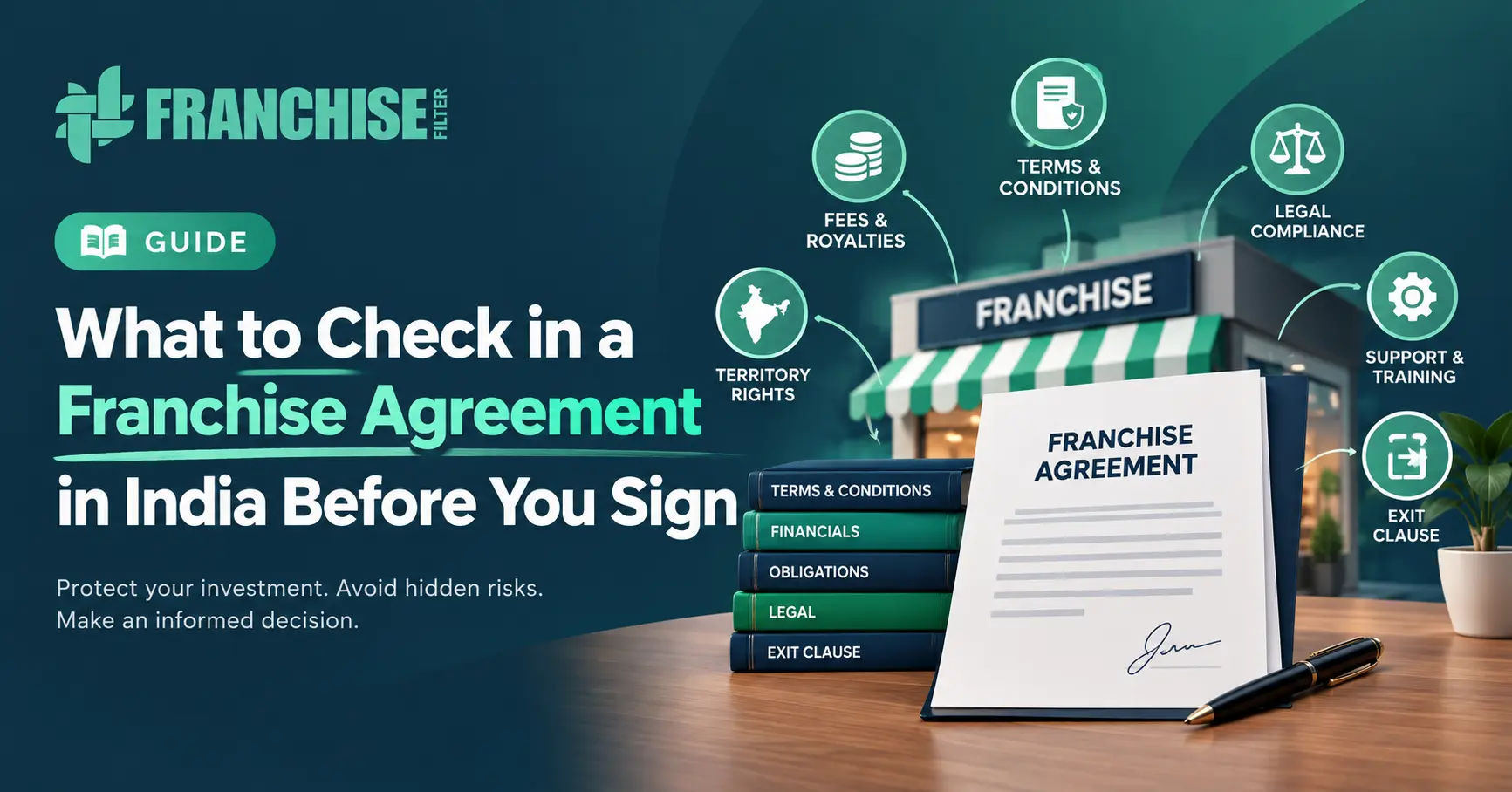
India has no dedicated franchise law. Your agreement is your protection, and nothing outside it counts once you sign. Find these nine clauses and read each one twice.
Franchise fee: what it covers, and whether it is staged or payable in full.
Royalty and its base: charged on gross sales, net sales, or purchases from the brand.
Ad fund contribution: the rate, and whether company-run outlets also pay in.
Term, lock-in and notice period: three separate numbers, not one.
Renewal conditions: the notice window, the fee, and whether you resign on current terms.
Territory rights: the area, the carve-outs, and who owns delivery app orders.
Supply obligations: what you must buy from the brand, and at what price.
Termination triggers: what lets them end it, and what cure period you get.
Exit costs: what leaving costs, and whether you can sell the outlet.
Also check the arbitration and jurisdiction clause. If the seat is Mumbai and your outlet is in Coimbatore, every dispute means travel and cost. Our clause-by-clause guide to the franchise agreement sets out what a fair version of each clause looks like.
Stage 7: Check the licences for your category, then get a lawyer
Work out which approvals your outlet needs, who applies for them, and who pays. These sit with you, not the brand, in most agreements.
Food and beverage: FSSAI registration or licence through foscos.fssai.gov.in, plus local health and fire clearances.
All categories: GST registration, Shops and Establishment registration with your state, and a trade licence from the local municipal body.
Education and childcare: state-level approvals and any applicable safety certification.
Health and wellness: practitioner qualifications and clinical establishment registration where it applies.
Then two final steps that cost very little and protect everything. Write down every verbal promise you were given, with the date and the person, and ask for each to be added to the agreement as a numbered clause. And have a local lawyer read the whole agreement before you sign. This guide explains how to check an opportunity. It is not legal advice and it does not replace that review.
The franchise due diligence checklist in one table
Print this and work down it. Score one point for every yes. Twelve or more, and the opportunity deserves serious attention. Seven or fewer and you are not ready to discuss money.
Check | Done |
|---|---|
Company found on MCA, status active, filings current | |
GSTIN verified, and the legal name matches the MCA record | |
Trademark found on IP India and status shows Registered | |
Trademark class covers the category you are opening in | |
Trademark is owned by the entity on your agreement | |
Outlets opened, closed and transferred in the last 24 months received in writing | |
Brand runs at least one outlet it owns and operates itself | |
Spoken to five franchisees you picked, including one who exited | |
Full cost sheet received, every line, not just the fee | |
Your own model built at 60 percent of projected sales | |
All nine key clauses read and understood | |
Royalty base and ad fund rate confirmed as separate numbers | |
Licence responsibilities and costs confirmed in writing | |
Every verbal promise added to the agreement in writing | |
Local lawyer has read the agreement |
Red flags that should stop the process
Any one of these is reason enough to pause. Two together is reason to walk.
Pressure to pay before you have seen the draft agreement.
A registration fee demanded to "block" a territory.
Refusal to share the full franchisee list, or insisting on sitting in on calls.
A trademark that is objected to, opposed, abandoned, or in the wrong name.
Projections presented as certainties, or any promise of assured monthly returns.
No company-run outlet anywhere, and no willingness to explain why.
A summary of the agreement offered instead of the agreement.
FAQs about franchise due diligence in India
How long should due diligence take?
Give it four to six weeks. India has no cooling-off period, so nothing forces a pause once you sign. Any pressure to decide this week is a sales tactic, not a deadline.
Can I do this myself or do I need a consultant?
Most of it you can do yourself. The MCA, GST and trademark checks are free and public. Pay for a lawyer to read the agreement, and an accountant to check the tax treatment of fees and royalties.
What if the brand will not share closure numbers?
Treat the refusal as the answer. Opened, closed, and transferred counts are the most revealing figures in franchising, and a brand with nothing to hide shares them without drama.
Is a bigger brand always safer?
No. A bigger brand usually means stronger systems and a stiffer agreement with less room to negotiate. Size reduces some risks and increases others. Judge the terms, not the logo.
How much should I budget beyond the franchise fee?
Far more than the fee itself. Deposit, interiors, equipment, stock, licences and six months of working capital typically add up to several times the fee. Ask for the complete cost sheet before you model anything.