Quick Summary
The best franchise business in India depends on your budget, your city, and how hands-on you want to be. In 2026, food and beverage, education, health and wellness, logistics, and retail are the strongest franchise categories. Entry investments range from ₹5 lakh to over ₹2 crore. This guide sorts each category by investment tier, explains the franchise models that affect your risk, gives you a scoring checklist to compare brands, and flags what to watch out for before you sign.
The biggest mistake first-time franchise buyers make is picking a brand before picking a category. A familiar logo feels safe. But if the investment does not match your budget, or the model does not match your availability, the brand name will not save you. Six months in, you are stuck in a lock-in with numbers that never worked for your location.
The smarter starting point is simple. How much can you invest? What city are you in? How hands-on do you want to be? Answer those three questions first, and the right category finds you.
If you are exploring a franchise business for the first time, this guide will help you match your budget to the right category, pick the right franchise model, and spot a weak opportunity before it costs you.
Top Franchise Categories Sorted by Investment
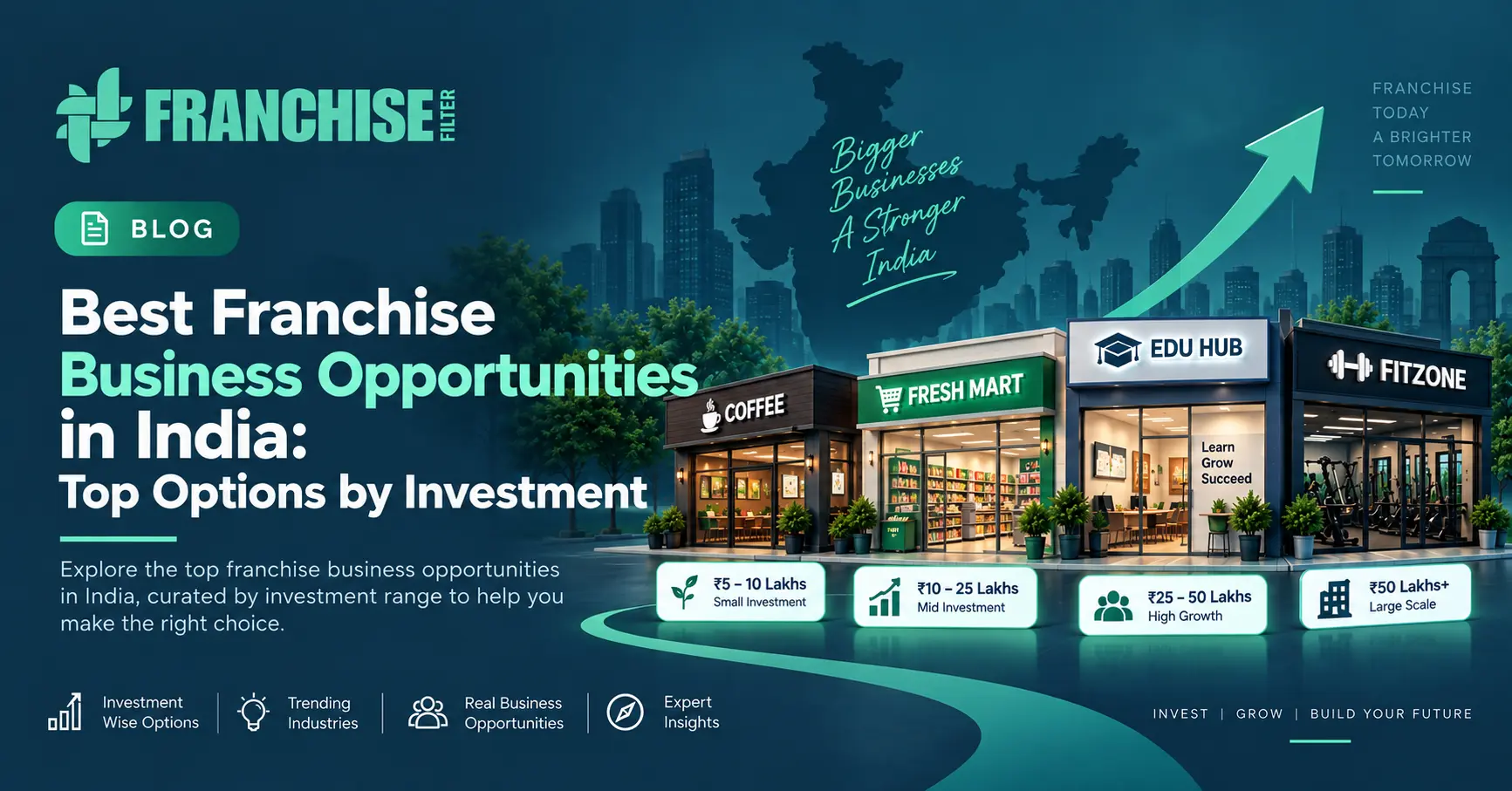
Your budget decides the category. Not your preference. Here are the five strongest franchise categories in India in 2026, with realistic ranges based on publicly available franchise disclosures.
Food and Beverage (₹5 Lakh to ₹2 Crore+)
The widest category. A chai kiosk starts at ₹5 lakh. A full QSR from a national brand can cross ₹1.5 crore.
Repeat consumption drives steady revenue. People eat every day.
Typical royalty: 4% to 8% of gross sales.
Break-even: 12 to 30 months depending on format and location.
Space needed: 200 to 2,000 sq ft. Key licence: FSSAI.
Watch out for: Mandatory supply purchases from the franchisor at marked-up rates. This quietly eats your margin.
Education and Training (₹8 Lakh to ₹40 Lakh)
Preschools, coding academies, test-prep centres, and vocational institutes. Demand stays stable because parents prioritise education regardless of the economy.
Recurring revenue from term fees. High retention if the product is good.
Typical royalty: 10% to 25% of fee collections, higher than most sectors.
Break-even: 12 to 24 months.
Space needed: 800 to 3,000 sq ft. Key licence: education board approvals.
Watch out for: Territory overlap. If the brand already has another franchise within 3 km, your catchment shrinks fast.
Health and Wellness (₹10 Lakh to ₹60 Lakh)
Diagnostic labs, clinics, pharmacies, gyms, and salon formats. India's shift toward preventive health is making this category grow.
Brand trust matters heavily in health. A known name gives you an edge over standalone setups.
Typical royalty: 5% to 15% of revenue.
Break-even: 18 to 36 months.
Space needed: 500 to 3,000 sq ft. Key licence: health or drug licence depending on format.
Watch out for: Licensing requirements. Labs need state health authority approvals. Pharmacies need a drug licence. The agreement must specify who handles these.
Logistics and Services (₹5 Lakh to ₹20 Lakh)
Courier franchises, laundry chains, home services, and EV charging stations. Lower glamour, but solid unit economics.
Low operating costs. Many models run from a small office or a vehicle.
Typical royalty: 0% to 10%. Some charge per-transaction fees instead of a percentage.
Break-even: 8 to 18 months.
Space needed: 100 to 500 sq ft. Key licence: trade licence.
Watch out for: Volume dependence. In a low-density area, transactions can be slow to build.
Retail and Apparel (₹25 Lakh to ₹2 Crore+)
Branded clothing, eyewear, electronics, and supermarket formats.
Customers already know the brand when they walk in. Less marketing effort on your end.
Typical royalty: 0% to 5%. Some work on a buy-and-sell model with no royalty.
Break-even: 24 to 48 months.
Space needed: 500 to 5,000 sq ft. Key licence: trade licence.
Watch out for: Inventory risk. If unsold stock is not returnable, that is real money sitting on your shelves.
Why the Franchise Model Matters as Much as the Brand
Most first-time buyers focus on the brand name and skip the model entirely. That is a mistake. The model decides your control, your workload, and your profit structure.
FOFO (Franchise Owned, Franchise Operated)
You own the outlet and run it. You hire staff, manage operations, and keep profits after royalty. Most common model. Most control, most responsibility.
FOCO (Franchise Owned, Company Operated)
You invest the money. The brand runs the outlet. You get a revenue or profit share without daily management. Good if you have capital but not the time.
A ₹30 lakh FOCO franchise and a ₹30 lakh FOFO franchise are very different commitments. Read our detailed breakdown of FOFO, FOCO, and COCO models before you decide.
Franchise Evaluation Scorecard
Before putting money into any franchise investment, rate each item from 1 (poor) to 5 (strong). A total below 20 out of 40 means negotiate harder or walk away.
Brand Track Record. How many outlets are currently operating? How many closed in the last 2 years?
Franchisee Satisfaction. Talk to at least 3 existing franchisees. Are they profitable? Would they sign again?
Royalty Clarity. Is royalty charged on gross sales, net sales, or purchases? Are there hidden marketing or tech fees?
Territory Protection. Does the agreement guarantee an exclusive area? What radius?
Exit Terms. What is the lock-in period? What is the early termination penalty? Can you resell?
Training and Support. Does the brand offer pre-launch training, ongoing ops support, and marketing help?
Supply Transparency. Are you forced to buy only from the franchisor? At what markup?
Lawyer Review. Has a qualified lawyer reviewed the full agreement?
This is educational content, not legal advice. Always have a qualified lawyer review your franchise agreement before signing. India has no dedicated franchise law. The agreement itself, governed by the Indian Contract Act, is your only real protection. For a clause-by-clause guide, read What Every Franchise Agreement in India Should Include.
Red Flags That Should Make You Walk Away
No franchisees to talk to. If the brand will not connect you with current owners, that is a problem.
Verbal income promises not in the contract. If they say "you will earn ₹1.5 lakh per month" during the pitch but refuse to put it in writing, it is not real.
Break-even claims under 6 months for a physical outlet. Be very sceptical.
High franchise fee with vague deliverables. A ₹5 lakh fee should buy defined training, brand assets, and operational support, not just the right to use a name.
Lock-in with no fair exit clause. A 5-year lock-in where the termination penalty equals the remaining term's royalty is designed to trap you.
India-Specific Costs Most Buyers Forget
When budgeting for franchise opportunities in India, factor in these commonly missed costs:
GST on franchise fees and royalties: 18% GST applies. On a ₹10 lakh fee, that is ₹1.8 lakh extra.
Stamp duty: Franchise agreements should be on stamp paper. Duty varies by state, from 0.5% to 5%.
Interiors and fit-out: Most franchisors specify exact design standards. This can be 30% to 50% of your total investment, separate from the franchise fee.
Working capital: Budget at least 3 months of operating expenses (rent, salaries, inventory) before revenue stabilises.
Local licences: FSSAI for food, drug licence for pharmacy, education board approvals for schools. Each has its own timeline and cost.
Where to Find Verified Franchise Opportunities
You can browse verified franchise opportunities on FranchiseFilter. We curate and verify the information brands share so you can compare options faster. We are a discovery platform, not an advisor, so always do your own due diligence before signing.
FAQs
What is the best franchise business in India for beginners?
Food kiosks, tea or juice bars, courier franchises, and preschool centres are common starting points. They need ₹5 to ₹15 lakh, offer structured training, and have tested models. The right pick depends on your budget, city, and available time.
How much money do I need to start a franchise in India?
Entry-level franchises start at ₹5 lakh. Mid-range options run ₹15 to ₹60 lakh. Premium formats cross ₹1 crore. Always add 20% to 30% to the franchise fee for GST, fit-out, licences, and working capital.
Is buying a franchise safer than starting from scratch?
A franchise gives you a tested brand, operating system, and supplier network. That reduces some risk. But it does not remove it. Your results depend on location, demand, management, and the franchisor's support. No franchise is a guaranteed income source.
Do I need a lawyer for a franchise agreement?
Yes. India has no franchise-specific law. The agreement is your only legal protection. A lawyer familiar with commercial contracts can catch one-sided clauses you might miss.
Can NRIs invest in a franchise in India?
Yes. Many brands accept NRI investors, especially in FOCO models where the brand handles operations. You will need to comply with FEMA regulations for inward remittance. A chartered accountant familiar with NRI investments can help.
Next Steps
Fix your budget. Decide the total capital you can invest, including working capital. Do not stretch beyond what you can afford to lose.
Pick a category. Use the comparison table above to shortlist one or two categories that match your investment and city tier.
Explore options. Browse verified franchise opportunities to compare brands in your category.
Talk to franchisees. Before going further with any brand, speak to at least 3 existing franchise owners. Ask about real monthly revenue, real costs, and whether they would sign again.
Get legal help. Have a local lawyer review the agreement before you sign. This is non-negotiable.
Read the fine print. Use our franchise agreement checklist to know exactly which clauses to look for.
The right franchise business in India can be a solid path to business ownership. But only if you pick the right category, the right brand, and protect yourself with the right agreement. Do the homework. Skip the hype. Never sign anything you have not fully understood.