Quick Summary: FOFO vs FOCO vs COCO at a Glance
A franchise model decides two things: who owns the outlet and who runs it. That single choice changes your capital, your daily hours, and who carries the risk.
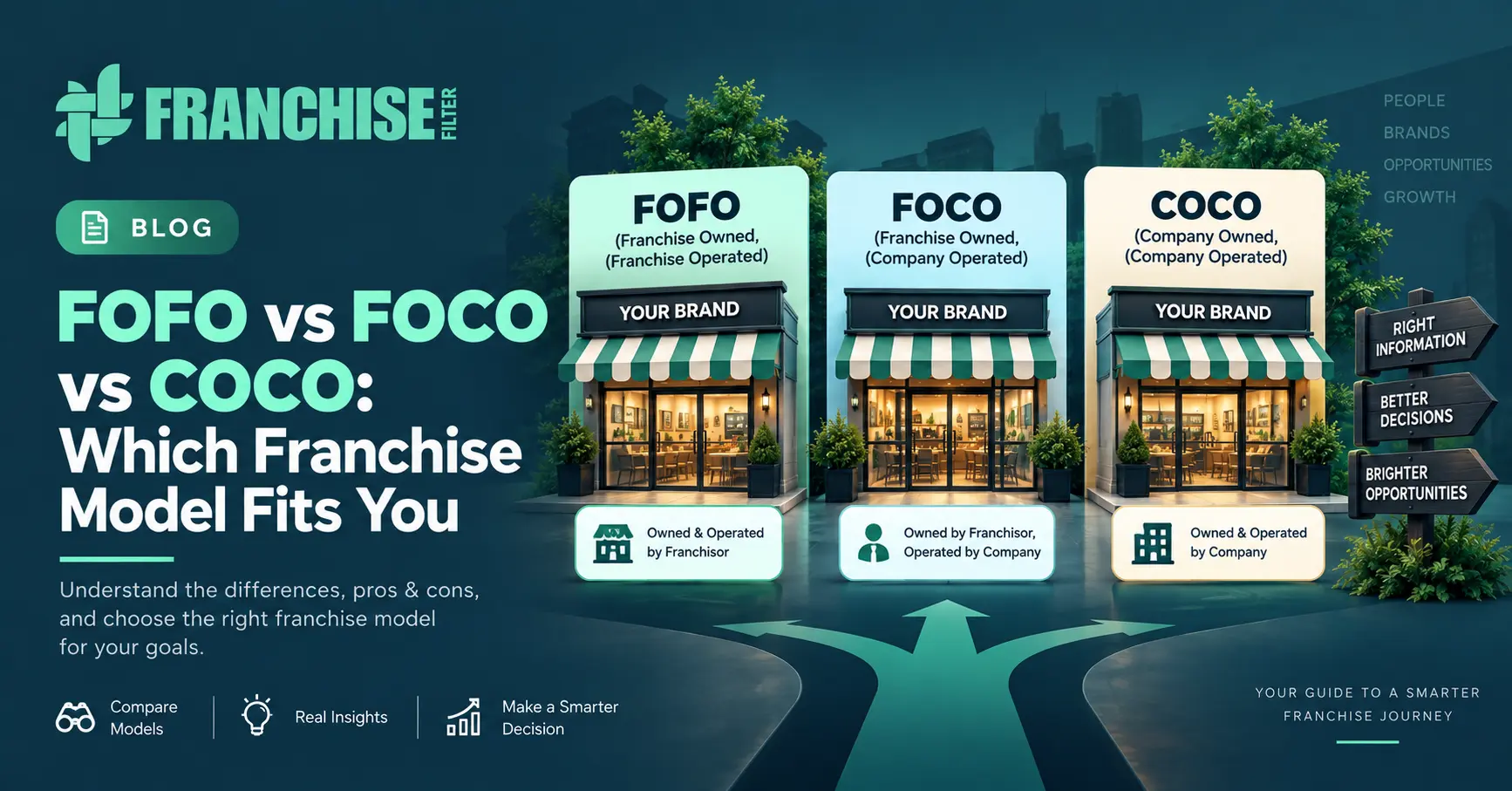
FOFO (Franchise Owned, Franchise Operated): you pay for everything and you run it. Most common model in India. Royalty usually 3% to 10% of sales
FOCO (Franchise Owned, Company Operated): you fund the outlet, the brand’s team runs it. Brands advertise returns of roughly 12% to 25% a year once the outlet stabilises, often after 2 to 3 years
COCO (Company Owned, Company Operated): the brand owns and runs it. This is not a franchise. You cannot buy one
COFO and FICO: less common hybrids where ownership and operations are split differently
There is no better model, only a better fit. FOFO suits people with time and appetite for control. FOCO suits people with capital and no time. Whichever you pick, the numbers live in the agreement, not the brochure.
Two people put Rs 30 lakh into the same brand in the same quarter. One chose FOFO, stood at the counter daily, and controlled his own costs. The other chose FOCO, was promised a monthly payout, and never asked who signs the staff salaries.
By month fourteen, only one of them knew where his money was going.
What a Franchise Model Decides About Your Money and Your Time
This section explains the two questions behind every model name, so the letters stop being confusing.
Every model name is two answers stuck together. Who owns the outlet, and who operates it.
Owns means who paid for the fit-out, deposit, equipment and stock, and whose name the lease sits in
Operates means who hires the staff, sets the roster, orders supplies, and answers when a customer complains
Answer those two and you know your capital exposure, your weekly hours, and who is accountable when sales drop. Everything else is detail.
The Five Franchise Models in India, Explained
This section defines each model in plain words and says who it actually suits.
FOFO: Franchise Owned, Franchise Operated
You buy the outlet and you run it. The brand gives you the name, the system, the training and the supply chain, and takes a royalty.
This is the default in Indian franchising. DTDC runs thousands of courier outlets this way, and most food and retail brands use it to expand.
It suits you if you want a business, not a deposit. You keep the upside, you carry the downside, and your own management is the biggest variable in the result.
FOCO: Franchise Owned, Company Operated
You pay for the outlet. The brand’s own team runs it and pays you a share, either a fixed monthly amount or a percentage of revenue or profit.
Tanishq uses this style of arrangement in many tier 2 and tier 3 towns, where the brand wants control of the counter but not the capital.
It suits you if you have money to deploy and no time to run a shop. It does not suit you if you need to see and fix problems yourself, because you will not be the one seeing them.
COCO: Company Owned, Company Operated
The brand owns the outlet and runs it with its own staff. Lenskart keeps a large share of its metro stores this way.
This is not a franchise model and you cannot buy into it. It matters only as a signal. A brand that keeps its best locations COCO and offers you the rest is telling you where it expects the money to be.
COFO and FICO: the two you will meet less often
COFO (Company Owned, Franchise Operated): the brand owns the outlet, you run it for a fee or profit share. Low capital, high effort, common in hospitality and fuel retail
FICO (Franchise Invested, Company Operated): you invest, the brand operates, and the split is defined case by case. Close to FOCO, but the word means different things at different brands
Ask for the definition in writing. Do not assume the letters mean the same thing everywhere.
Franchise Models Compared: Investment, Control, Returns and Risk
This section puts the five models side by side so you can see the trade-off in one screen.
Model | Who owns | Who operates | Your time | Your capital | How you earn | Main risk |
FOFO | You | You | Full time | High | Profit after royalty | Your own operations |
FOCO | You | Brand | Very low | High | Fixed payout or revenue share | The brand’s operations and its ability to pay |
COCO | Brand | Brand | None | None | Not open to you | Not applicable |
COFO | Brand | You | Full time | Low | Operating fee or profit share | No asset at the end |
FICO | You | Brand | Very low | High | Defined in the contract | Undefined terms |
Read the last column twice. In FOFO your risk is your own effort, which you can improve. In FOCO your risk is someone else’s effort, which you cannot.
FOCO Franchise Model: How Fixed Returns Actually Work
This section covers the part of FOCO that brochures skip, and it is the reason most FOCO disputes happen.
FOCO is often sold as passive income. A monthly figure, a percentage, a neat table of payouts. Here is what sits underneath it.
A promised return is a contractual obligation, not an outcome. It is only as reliable as the company promising it. A brand under pressure may renegotiate or delay
Check the base. A share of revenue and a share of profit are very different numbers. Profit share means you absorb cost decisions made by someone else
Ask who signs the costs. Staff salaries, electricity, rent escalation and stock write-offs are usually charged to the outlet, which is yours
Ask for outlet-level reporting. Monthly sales, costs and footfall in writing, not a payout figure with no working
Check the exit clause. Find out what happens if the brand stops operating the outlet, and whether you can take it over
Returns quoted in the market run roughly 12% to 25% a year once an outlet stabilises, which often takes two to three years. Treat those as advertised ranges, not promises. Actual earnings depend on location, footfall and how the outlet is run.
What Changes in Your Franchise Agreement With Each Model
This section shows which clauses shift when the model changes, so you know what to read first.
The clauses that change most
Control and decision rights: in FOCO, spell out what you can and cannot decide. Pricing, staffing, closing hours, and whether you can enter the outlet
Payout mechanics: the amount, the base, the payment date, and the penalty if a payment is late
Termination: what happens to your fit-out and equipment if the brand stops operating your outlet
Transfer: whether a FOCO outlet can later convert to FOFO, and at what cost
Licences and liability usually stay with the owner
This is the most expensive assumption in FOCO. You own the outlet, so the paperwork tends to sit with you even though someone else runs it.
FSSAI registration or licence for a food outlet is usually in the outlet owner’s name
GST registration, trade licence and shop and establishment registration typically follow ownership
Staff liability under PF, ESIC and the labour codes depends on who is the employer on record, so get that named in the agreement
Get each of these assigned in writing. A regulator’s notice goes to the name on the licence, not to the team that made the mistake.
Tax does not change, whoever operates
GST at 18% applies to franchise fees and royalty payments
Under Section 194J you deduct 10% TDS on royalty paid to a resident franchisor
The agreement needs stamping under your state stamp act, or it may not be accepted as evidence in a dispute
Have a qualified lawyer read the agreement before you sign it. This article is educational content, not legal advice.
How to Choose the Right Franchise Model: A 15-Point Scorecard
Answer honestly. Count your yes answers in each column before you decide.
# | Question | Points to FOFO | Points to FOCO |
1 | Can I give this 40 or more hours a week | Yes | |
2 | Do I want to control pricing and staffing | Yes | |
3 | Have I run a team before | Yes | |
4 | Do I live within 30 minutes of the outlet | Yes | |
5 | Am I comfortable with income that varies monthly | Yes | |
6 | Do I want the upside if the outlet does very well | Yes | |
7 | Am I willing to learn the operations myself | Yes | |
8 | Is this my primary income | Yes | |
9 | Do I already have a full-time job or business | Yes | |
10 | Do I want a predictable monthly figure | Yes | |
11 | Am I fine never making daily decisions | Yes | |
12 | Do I trust this brand’s operating record over my own | Yes | |
13 | Can I afford this money to be locked for 3 years | Yes | |
14 | Have I verified the brand’s audited financials | Yes | |
15 | Do I have outlet-level reporting promised in writing | Yes |
Mostly the FOFO column: FOFO fits you. Budget for working capital and your own time
Mostly the FOCO column: FOCO fits you, but only with a brand whose financials you have checked
Split down the middle: you are not ready to choose yet. Visit three outlets of each type first
Final Thought on Choosing the Best Franchise in India
The best franchise in India for you is the one whose model matches your life, not the one with the highest advertised return.
FOFO asks for your time. FOCO asks for your trust. Both ask for your money. Decide which of those you can actually afford to give, then read the agreement for the model you picked.
Franchise Model FAQs
What is the difference between FOFO and FOCO?
In FOFO you own the outlet and run it yourself, keeping the profit after royalty. In FOCO you own the outlet but the brand’s team runs it, and you receive a fixed payout or a revenue share. FOFO gives control, FOCO gives time back.
Which franchise model is most common in India?
FOFO. Most Indian brands expand through franchisees who fund and operate their own outlets, because it lets the brand grow without spending its own capital. FOCO is growing in retail and food, and COCO is usually reserved for flagship or metro locations.
Is COCO a franchise model I can invest in?
No. COCO means the company owns and operates the outlet itself, with no franchisee involved. If a brand describes a COCO opportunity to you, ask exactly what you would own and who would operate it, because the label is being used loosely.
Are FOCO returns guaranteed?
No. A promised payout is a contractual obligation, and it depends entirely on the company’s ability to pay. Check the brand’s financials, the payout base, and what happens if it stops operating your outlet. Earnings vary with location, footfall and management.
Can I switch from FOCO to FOFO later?
Only if your agreement allows it. Most do not say anything, which means you cannot. If you think you may want to take over operations later, get the conversion path, the notice period and the cost written in before you sign.
Next Steps Before You Pick a Franchise Model
Do these five things in this order.
Decide your model using the scorecard above, then only shortlist brands that offer it.
Ask each brand for a written break-up of total investment, royalty or payout base, and expected break-even. A brochure figure is not enough.
For FOCO, ask for the brand’s audited financials and outlet-level reporting format. If neither is shared, stop there.
Visit three operating outlets and speak to the franchisees without the brand present.
Send the agreement to a local lawyer. Our guide on what to check in a franchise agreement lists the exact clauses, and our roundup of the best franchise business opportunities in India shows what each tier of franchise investment actually buys.
When you are ready to compare models side by side, browse verified franchise opportunities on FranchiseFilter. We list the model for every brand, so you can shortlist franchise opportunities in India by how you want to work, not just what you want to spend. That is a faster way to narrow a franchise business in India than comparing brochures.
FranchiseFilter is a discovery platform. We verify the information brands provide, and we do not guarantee investment returns. Outcomes depend on location, footfall, and how the outlet is run.