Quick summary
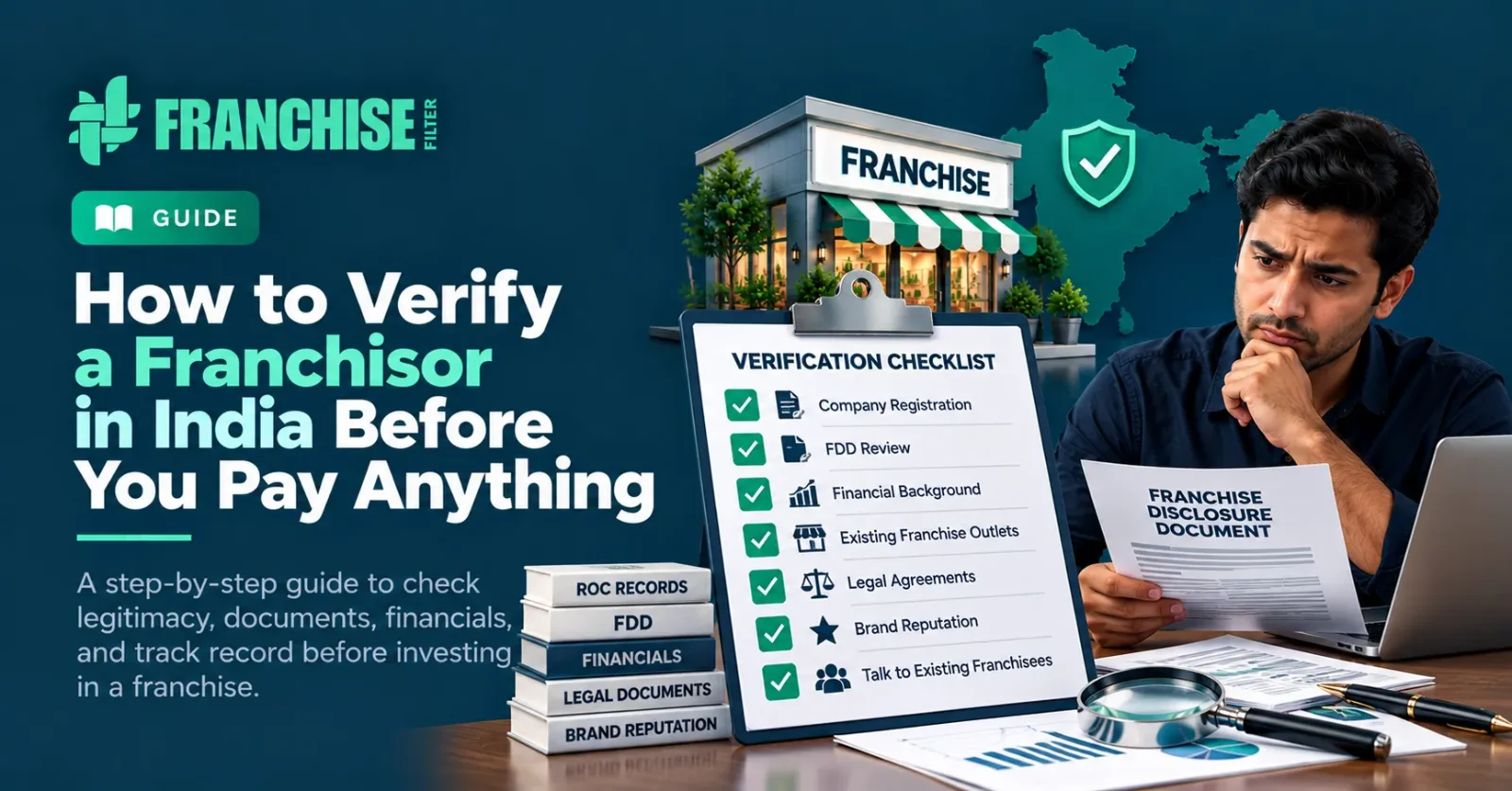
Eight checks tell you whether a franchisor is real, solvent and owns the brand it is selling you. All eight are free, all eight use public records, and together they take one working day. Most buyers do none of them.
A man in Nagpur paid a deposit to a food brand that looked solid. Registered company, active status on the MCA portal, a proper invoice with a GSTIN on it. What he never opened was the GST return filing table, which showed the company had not filed a return in seven months. The brand collapsed four months after he opened his outlet.
Nothing he was shown was fake. Everything he needed was public. He just did not know where to look.
Why verifying a franchisor in India is entirely your job
There is no safety net here, and it helps to know that before you start.
India has no dedicated franchise law and no franchise regulator.
No disclosure document is required, so nothing forces a brand to tell you anything.
Nobody reviews or approves a franchise offer before it reaches you.
There is no cooling-off period once you sign.
The agreement itself, under the Indian Contract Act, is your only real protection.
The upside is that India keeps an unusual amount of company data in the open. Anyone evaluating a franchise business in India can check far more than they realise, for free, without asking the brand for permission and without tipping them off that you are looking.
Check 1: Work out what kind of entity you are actually dealing with
Before any portal search, settle one question. Is the franchisor a company, a partnership, or one person trading under a brand name? The answer changes every check that follows, and it changes what happens if things go wrong.
The six-second test hiding in the GSTIN
A GSTIN is fifteen characters. Positions three to twelve are the entity’s PAN. The fourth character of that PAN, which is the sixth character of the GSTIN, tells you the entity type.
6th char | Entity type | What is publicly available | Your recourse if it goes wrong |
|---|---|---|---|
C | Company | MCA filings, financials, directors, charges | Limited to the company’s assets |
F | Firm or LLP | LLP filings on MCA. Partnership firms, almost nothing | Partners may be personally liable |
P | Proprietorship | Little beyond GST registration | The individual is personally liable |
A or B | Association or body of individuals | Very little | Depends entirely on the constitution document |
T | Trust | Limited, varies by registration | Governed by the trust deed |
Why the entity type changes everything
Most buyers assume a private limited company is automatically the safest counterparty. It is the most transparent, which is not the same thing.
With a company, your claim usually stops at the company’s assets. If it has almost none, a judgment in your favour may be worth very little. With a proprietorship, you get almost no public information, but the owner is personally liable, which can mean more real recourse, not less.
Neither is better. The point is to know which one you are in before you decide how much verification the rest of the deal needs.
What to do if the franchisor is not a company
Ask for the proprietor’s or partners’ PAN and a copy of the partnership deed.
Check whether the firm has a Udyam registration and verify it on the official portal.
Ask for the Shops and Establishment registration for their own premises.
Ask for two years of income tax returns, since there will be no filed accounts to look at.
Expect more pushback than you would get from a company, and treat a flat refusal as information.
Check 2: Read the MCA company master data properly
If the entity is a company or LLP, go to mca.gov.in and open the master data search. Enter the exact legal name on your draft agreement, not the brand name on the shopfront. They are very often different, and the difference matters.
Company status, and why "Active" proves almost nothing
Active is the weakest signal on the page. It means the company is on the register and can file forms. It does not mean the filings are current, the accounts are clean, or the business is trading.
Status you may see | What it means for you |
|---|---|
Active | On the register. Check the other fields before you relax. |
Dormant under Section 455 | Formally dormant. Not always a defect, but needs explaining. |
Under process of striking off | Removal has begun. Stop and take advice. |
Strike off | Removed from the register. Walk away. |
Under liquidation or liquidated | Insolvency or winding up. Walk away. |
Amalgamated or Converted to LLP | The entity has changed. Confirm who you are contracting with. |
The four fields that actually tell you something
Date of last AGM. If it is two years old, governance has slipped.
Date of balance sheet. This is the last financial year for which accounts were filed.
Paid-up capital against authorised capital. A gap is normal. Very low paid-up capital on a brand claiming national scale deserves a question.
Date of incorporation. A company registered last year cannot have a ten-year track record, whatever the brochure says.
Check the index of charges
A charge is security the company has given against borrowing. Look at the charge holder, the amount, the date it was created, and whether a satisfaction has been recorded.
Open charges with no satisfaction may simply be a paperwork gap. They may also be live debt secured against the assets of the company you are about to depend on. Ask which it is, and ask in writing.
Check 3: Confirm the franchisor is actually filing GST returns
This is the check almost nobody runs, and it is the one most likely to show you trouble before anyone else sees it.
How to do it
Go to gst.gov.in and open Search Taxpayer, then search by GSTIN.
Confirm the legal name and trade name match the MCA record exactly.
Check the registration date against the trading history the brand claims.
Scroll to the goods and services section and open the filing table.
Select the financial year and read the month-wise list of returns filed.
What you are looking for
Gaps. A company that has stopped filing GSTR-3B for several months is usually a company with a cash problem, and that shows up here long before it shows up in the market or in anyone’s gossip.
A brand with a clean, unbroken filing record across two financial years is telling you something real. A brand with four missing months is telling you something too.
Active, suspended and cancelled
Check the registration status itself, not only the filings. A cancelled GSTIN on the entity you are contracting with is a full stop. A suspended one needs an explanation before anything else happens.
Also note the filing frequency. A brand filing quarterly under the small-taxpayer scheme is, by definition, below the turnover threshold for monthly filing. That is not a problem on its own. It is useful context when the same brand is describing itself as a national chain.
Check 4: Confirm the brand owns the trademark it is licensing to you
You are paying for the right to use a name. Search it on the public trademark database at ipindiaonline.gov.in, by wordmark, exactly as it appears on the signage. Our full due diligence checklist covers the status values in detail. Four things matter here.
Status. Only "Registered" means owned. Objected, Opposed, Abandoned and Refused all mean they do not own it yet.
Class. A mark registered for packaged goods gives no protection to a restaurant. Confirm it covers your category.
Owner. If the mark sits with a director personally or a different group company, the entity on your agreement may not own what it is licensing you.
Date. A mark filed three months ago on a brand claiming six years of history is worth a question.
If the owner is a different entity
This is common in group structures and is not automatically a problem. Ask for the licence chain in writing, showing how rights pass from the registered owner to the company you are signing with, and have a lawyer confirm the chain actually connects.
If there is no registered trademark at all
Then you are buying a name anyone can copy, including a former franchisee opening across the road. Some early-stage brands are genuinely still in the application process, which is fine if they say so and the application is live. A brand that implies registration it does not have is a different matter.
One practical tell. The ® symbol may only be used with a registered mark. ™ carries no such weight and anyone can print it.
Check 5: Look at the directors, not only the company
The company may be new. The people behind it usually are not. Director master data on the MCA portal, searched by DIN, shows every company a person is linked to.
How many other companies is each director attached to, and are those trading or dormant?
Has the same group launched and quietly closed similar brands before, under different names?
Do the directors have operating experience in this category, or only experience selling franchises?
Are any directors disqualified, which can follow three consecutive years of non-filing at another company?
Then search the company name and the director names on the eCourts services portal, and check the NCLT site for insolvency filings. You are not looking for a single case, since any active business collects a few. You are looking for a pattern, and specifically for disputes with former franchisees.
Check 6: Check the brand’s digital footprint for its real age
Brands inflate their history more often than they invent it outright. Three free checks usually settle how old the business really is.
Domain age
A WHOIS lookup shows when a domain was first registered. A brand claiming eight years of operations with a domain created fourteen months ago has some explaining to do. Domains can be bought second-hand, so ask rather than assume, but ask.
Outlet reviews on Google
Search the brand on Google Maps and sort the reviews on an outlet by oldest first. The first review is a rough floor for when that outlet opened. Do this across three or four locations and you get a real picture of the rollout, independent of the brochure.
Social proof against social noise
Follower counts mean very little. What to look at instead is whether real customers tag the outlets, whether the brand replies to complaints, and whether posts about new openings continue into the recent past or stop two years ago.
A brand whose last genuine opening post is from 2024, while its deck claims rapid expansion, is worth a direct question.
Check 7: Verify the franchise brand physically, not on video
Photographs prove nothing and a video call proves less. Three visits settle most remaining questions.
The registered office
Turn up unannounced at the address on the MCA record. A working office with staff is a good sign. A shared desk, a locked door or a residential flat is not automatically fatal, but it needs a straight answer.
A company-run outlet
Sit in one for thirty minutes on a weekday afternoon, not during a scheduled tour. Count customers. Watch how staff handle a complaint. Look at whether the equipment is maintained and whether the place is actually clean behind the counter.
A franchised outlet in another city
Do the same at an outlet the brand did not send you to. The gap between the company-run outlet and the franchised one tells you how much of the system actually travels, and how much of it depends on head office standing over people.
Check 8: Find franchisees the brand did not introduce you to
Three hand-picked references are a marketing asset, not evidence. Here is how to build your own list before buying a franchise.
Search the brand name on Google Maps city by city. Each pin is often a separate owner.
For food brands, check delivery platform listings, which often cover outlets the brand does not advertise.
Look at local business directories and the brand’s own store locator page.
Check Instagram location tags and photos the brand has been tagged in.
Search the brand name with "franchisee" or "owner" on LinkedIn.
Look for outlets that have closed, using old reviews and listings marked permanently closed.
How to make the call
Call the outlet directly and ask for the owner. Say plainly that you are considering a franchise with the same brand and would value ten minutes. Most owners will talk, often at length. The ones who hesitate are telling you something as well.
What to ask
What did it actually cost you to open, compared to what you were quoted?
How many months until you covered your monthly running costs?
What does the brand charge you that you did not expect?
How fast do they respond when something breaks?
Has anyone from head office visited this outlet in the last six months?
Would you sign the same agreement again today?
An owner who has closed or sold is the most valuable call you will make. Find one. The brand will not give you their number, which is exactly why it is worth finding.
How long the franchisor verification process takes
None of this is expensive. It is mostly a question of doing it in a sensible order before you are emotionally committed.
Stage | Rough time | What it costs |
|---|---|---|
Checks 1 to 4, all portal work | One afternoon | Nothing |
Check 5, directors and disputes | One to two hours | Nothing |
Check 6, digital footprint | One hour | Nothing |
Check 7, physical visits | One to two days | Travel only |
Check 8, franchisee calls | One week, spread out | Nothing |
Lawyer review of the agreement | One to two weeks | Professional fee |
Four to six weeks end to end is reasonable. India has no cooling-off period, so nothing forces a pause once you sign. Any pressure to decide this week is a sales tactic, not a deadline.
The franchisor verification scorecard
Work down this list before any money moves. Score one point for every yes.
Check | Yes or no |
|---|---|
Entity type identified from the GSTIN and confirmed | |
Company or LLP found on MCA with the exact name on the agreement | |
Status is Active, not dormant, struck off or under liquidation | |
Last AGM and balance sheet dates are within the last financial year | |
No unexplained open charges against the company | |
GSTIN active, and legal name matches the MCA record | |
GST returns filed without gaps across the last 24 months | |
Trademark status shows Registered on the IP India portal | |
Trademark class covers your category | |
Trademark owner is the entity on your agreement, or the chain is documented | |
Directors have operating experience, not only franchise sales | |
No pattern of disputes found on eCourts or NCLT | |
Domain age and review history match the claimed trading history | |
Registered office visited unannounced and looks real | |
At least one company-run outlet visited on a normal weekday | |
Five franchisees contacted that the brand did not nominate | |
At least one former franchisee spoken to |
Fourteen or more is a franchisor worth negotiating with. Nine or fewer, and you are not ready to talk about money.
How to raise what you find without killing the deal
Most findings are not deal-breakers. They are questions. How you ask decides whether you get an answer or a wall.
Ask as a buyer, not as an investigator
"I noticed the trademark is registered to a different company; can you help me understand the structure?" lands very differently from "your trademark is not in your name". You usually want the deal to work. Ask like it.
Put every question in writing and keep the reply
Email, not a phone call. Not because you are building a case, but because an answer in writing is an answer you can later ask to have added to the agreement as a clause.
Separate what can be fixed from what cannot
Fixable: an unclear licence chain, a missing cost line, a clause nobody has explained.
Not fixable: a struck-off company, a cancelled GSTIN, a refused trademark, a pattern of franchisee litigation.
Whatever the score, have a local lawyer read the agreement before you sign it. This guide explains how to check a brand and is not a substitute for that review. Our clause-by-clause guide to the franchise agreement covers what to look for in the contract itself.
FAQs about verifying a franchisor in India
Can I check a franchisor for free?
Yes. MCA master data, GST taxpayer search, IP India trademark search, eCourts and NCLT are all free and public. The only cost is your time, and the full set takes about one working day.
What does Active status on MCA actually prove?
Very little on its own. It means the company is on the register and can file forms. Check the last AGM date, the balance sheet date and the filing history before you treat it as reassurance.
How do I know if a franchisor is in financial trouble?
Gaps in the GST return filing table are the earliest public signal. Also look at open charges on MCA, an old balance sheet date, and any insolvency filings on the NCLT site.
What if the franchisor is a proprietorship, not a company?
You lose most of the public record, so ask for PAN, income tax returns and any Udyam registration instead. The owner is personally liable, which can mean more real recourse than a company with no assets.
What if the trademark is registered to a different company?
Ask for the licence chain in writing, showing how rights pass from the owner to the entity you are signing with. If that chain does not exist or does not connect, you may be paying for a name the seller cannot license.
How many franchisees should I speak to?
At least five, and find them yourself rather than taking a shortlist. Include one who has closed or sold. That conversation usually teaches you more than the other four combined.