
Quick summary
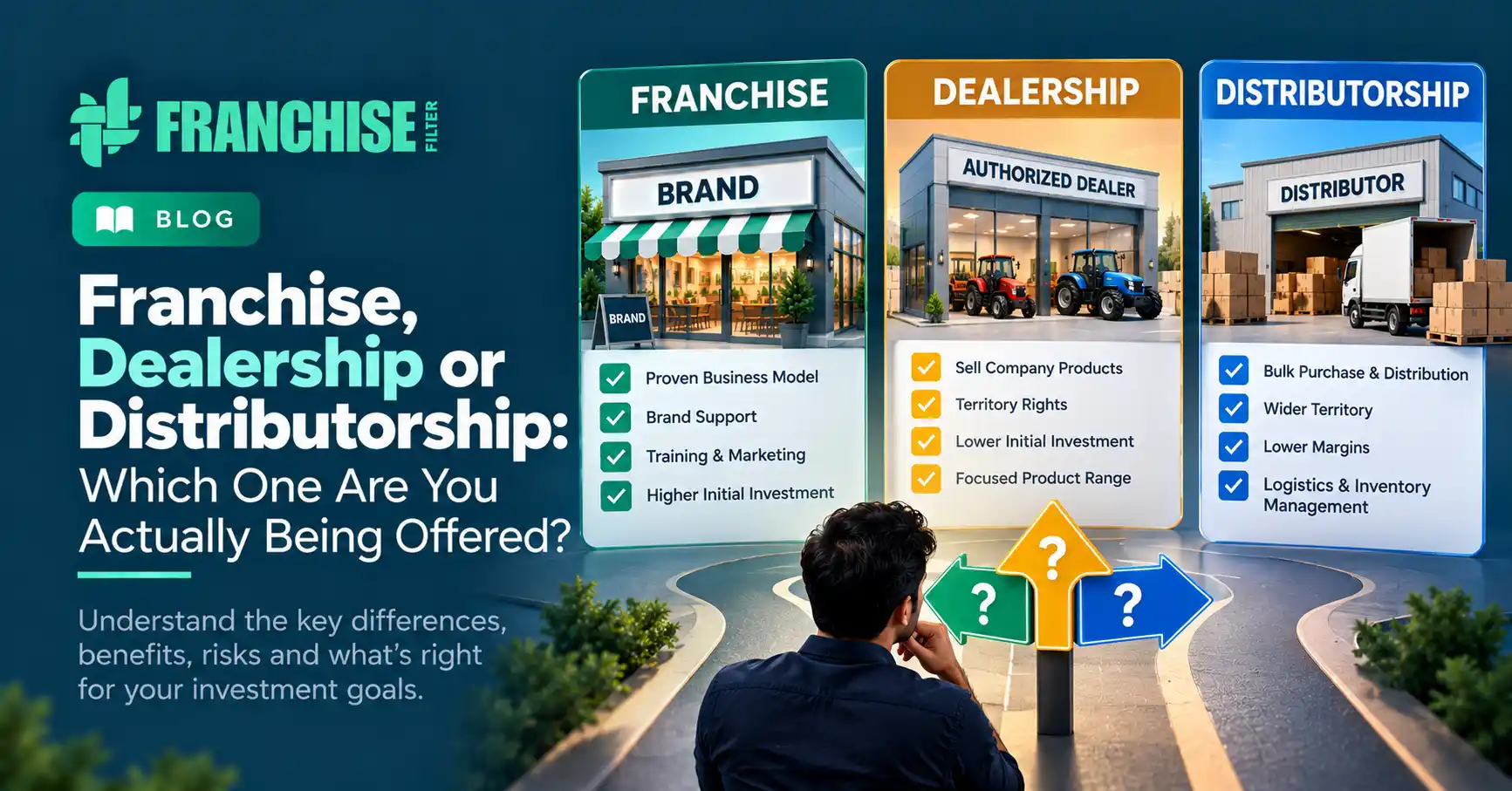
A franchise licenses you a brand and a system, and charges you for using them. A dealership sells you products to resell under the maker’s name. A distributorship sells you products in bulk to supply onward to retailers. The title on the agreement does not decide which one you have. The clauses do.
A man in Surat was offered what the brochure called a dealership. No royalty, it said, keep your full margin. The agreement licensed the brand name, fixed his store layout, set his selling prices and took a monthly percentage of his sales. He had been sold a franchise with a different cover page, and he found out when he tried to leave.
Here is the thing. Most articles on this compare the three models as if everyone agrees what they mean. In practice, the words get used loosely, sometimes carelessly and sometimes deliberately.
Franchise, dealership and distributorship compared
Start with what each one actually is, on the points that affect your money.
What you are checking | Franchise | Dealership | Distributorship |
|---|---|---|---|
What you are buying | The right to use a brand and run its system | Stock to resell to customers | Stock to supply onward to retailers |
Who you sell to | End customers | End customers | Shops and other businesses |
Paid up front | Franchise fee, deposit, full fit-out | Mostly inventory and some setup | Mostly inventory and warehousing |
Paid every month | Royalty and usually an ad fund | Nothing, you earn on margin | Nothing, you earn on margin |
Whose name is on the door | The brand’s | Usually yours, with their product | Usually no shopfront at all |
Who sets the selling price | Usually the brand | Usually you | Usually you |
What you hold if it fails | Little, the fee is spent | Stock you can sell | Stock you can sell |
The question that matters more than the label
Most comparisons stop at the table above. The more useful question is whether the agreement in front of you behaves like what it claims to be. In any franchise business in India, substance beats the heading on page one.
Six clauses that make it a franchise, whatever it is called
You are licensed to trade under the brand name, not just to stock its products.
The agreement controls your premises, layout, signage or uniform.
You must buy specified items from the brand or its nominated suppliers.
You pay a recurring amount linked to your sales, by whatever name.
The brand sets or approves your selling prices.
There is a territory clause, a term, and restrictions on what you do afterwards.
Four or more of those and you are looking at a franchise. The risk is not the word. The risk is being handed franchise-level obligations while being told you have a dealership, and therefore never asking the questions a franchise buyer would ask.
Why some offers are labelled dealership on purpose
"No royalty" is an easier sell than "six percent of your sales every month". So the same payment reappears as a marketing charge, a system fee, a software subscription, or a margin on compulsory stock.
Add up everything you will pay the brand in a year, then divide by your expected sales. That percentage is your real royalty, whatever the agreement calls the line items.
Where your money goes, and what you can get back
This is the difference that decides how much a failure costs you, and almost nobody writes it down.
In a franchise, most of your money is spent
The franchise fee is gone the day you pay it. The fit-out is worth a fraction of what it cost once it is installed, and branded fittings are worth less still because nobody else can use them.
In a dealership or distributorship, most of your money is stock
Stock is an asset. If the business does not work, you can sell it, often at a discount, sometimes back to the supplier if the agreement allows returns. You rarely recover everything, but you recover something.
What to ask before you choose
If I stop in month nine, what do I physically still own?
Will the supplier buy back unsold stock, and at what percentage?
Is any part of the fee refundable if the site or a licence never comes through?
A franchise can still be the better choice. A proven system and a known name are worth paying for. But price that choice knowing the money behaves differently, and build the full cost sheet before you decide. Our due diligence checklist sets out every line to ask for.
GST works differently in a franchise and a dealership
Two models, two completely different tax flows, and this one shows up in your bank account every month.
Franchise
The franchise fee and royalty are treated as a service, so GST applies on top, currently at 18 percent.
If you are registered and your sales are taxable, that GST is usually available as input tax credit.
Ask for a proper tax invoice with the franchisor’s GSTIN every single month.
Dealership and distributorship
You are buying goods, so GST applies at the rate for that product, not a flat service rate.
That GST sits in your working capital from the day you buy the stock until you sell it.
A slow-moving product ties up both your cash and the tax paid on it.
Nobody compares these two side by side, and it matters. A distributorship with ninety days of stock on the shelf has very different cash flow from a franchise paying royalty on what it already sold.
Who controls your selling price, and why it matters
In a dealership, you normally set your own prices. That freedom is most of the point. When you compare franchise opportunities, expect the opposite: a franchisor usually sets prices because consistency across outlets is part of what you are buying.
There is a legal edge here worth knowing. A supplier that dictates the price you must resell at can raise resale price maintenance questions under the Competition Act, which are assessed on their effect rather than banned outright. A franchisor setting menu prices as part of brand standards sits on different ground.
You do not need to resolve that yourself. You do need to notice when a supplier calling itself a dealership is behaving like a franchisor, and ask a lawyer which one your agreement actually creates.
Five questions that tell you which one you are being offered
Ask these before you sign anything. The answers settle it faster than the title does.
Question | Your answer |
|---|---|
Am I licensed to use the brand name, or only to sell its products? | |
Does anyone control my premises, layout, staff or opening hours? | |
Do I pay anything recurring that is linked to my sales? | |
Who decides the price the customer pays? | |
If I stop in month nine, what do I still physically own? |
Brand licence, control over your premises and a recurring charge on sales together mean franchise, whatever the cover page says. Have a local lawyer read the agreement and tell you which relationship it actually creates, then work through our clause-by-clause guide to the franchise agreement before you negotiate.
FAQs about franchise, dealership and distributorship
Is a dealership cheaper than a franchise?
Usually cheaper to start, because you are buying stock rather than paying a fee and a fit-out. The money also behaves differently. Stock is an asset you can sell, while a franchise fee is spent the day you pay it.
What is the difference between a dealer and a distributor?
A dealer sells to end customers. A distributor supplies shops and other businesses. Distributors usually need warehousing and far more working capital, and they rarely have a customer-facing shopfront.
Can an agreement be a franchise even if it says dealership?
Yes. The clauses decide, not the title. If you are licensed to use the brand, controlled on premises and pricing, and charged a recurring amount linked to sales, it behaves like a franchise.
Do I pay royalty in a dealership?
Not usually by that name. Check for marketing charges, system fees, software subscriptions and margins on compulsory stock. Add up everything you pay the brand in a year and divide by expected sales.
Which model is better for a first-time owner?
Neither is better in general. A franchise buys you a proven system at a recurring cost. A dealership keeps more freedom and more of the money recoverable. Choose by how much support you need and how much you can afford to lose.